Free Friendship Activities for Kids | Good Friend or Not a Good Friend Task Cards
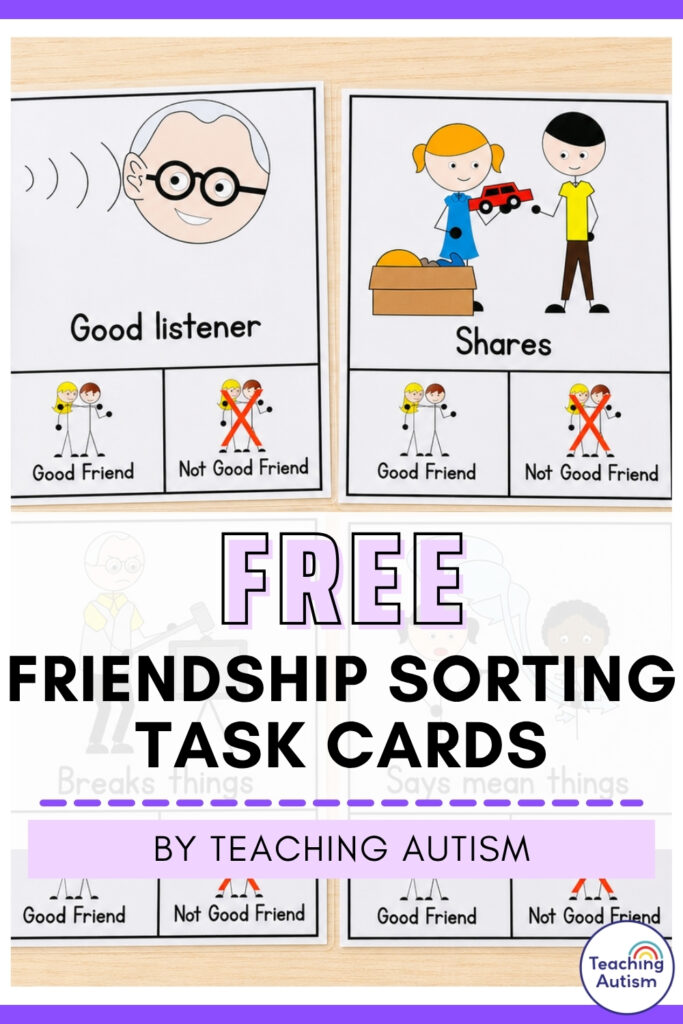
If you are looking for free friendship activities to help students build social skills and better understand positive social behaviors, these Good Friend or Not a Good Friend Task Cards are such a fun and engaging way to introduce friendship concepts in the classroom. Social skills can sometimes feel difficult to teach directly, which is why I love using visual and hands-on activities that help students explore real life situations in a clear and meaningful way.

Friendship skills are something many students need ongoing support with, especially when it comes to understanding expected social behaviors, perspective taking, communication, and social problem solving. Activities that break these concepts down visually can make such a huge difference for students who benefit from structured and explicit teaching.
Why Friendship Activities Are So Important
Friendship and social interaction skills are part of everyday life in the classroom. From playing with peers to sharing materials and working together during group activities, students are constantly navigating social situations throughout the school day.
For some students, these social expectations come naturally. But for many students, especially autistic students and students with additional support needs, social interactions can feel confusing, overwhelming, or unpredictable.
This is why direct teaching of friendship skills can be so helpful.
Students often benefit from explicit opportunities to explore:
- What makes a good friend
- Positive social interactions
- Expected vs unexpected behaviors
- How actions affect others
- Social problem solving
- Kindness and empathy
- Perspective taking
Using visual social skills activities gives students the opportunity to practice these concepts in a safe, structured, and supportive way.
Why I Love Using Social Scenario Activities
One of my favorite ways to teach social emotional learning and friendship skills is through social scenarios.
Instead of simply talking about friendship rules, students can actually look at situations, think about the behaviors shown, and make decisions about whether those actions demonstrate good friendship skills.
This helps make abstract social concepts much more concrete and understandable.
In these friendship sorting task cards, students look at a variety of real life social situations and decide whether the behavior shows:
- A good friend
- Not a good friend
This creates so many opportunities for meaningful discussion and social learning.
Skills Students Can Practice
Although these activities are simple to set up, students are working on many important social and communication skills while completing them.
Some of the skills practiced include:
- Social skills development
- Friendship skills
- Social emotional learning
- Categorizing
- Decision making
- Perspective taking
- Communication skills
- Identifying expected behaviors
- Understanding social situations
Activities like this can also help encourage classroom discussions around kindness, empathy, teamwork, and positive peer interactions.
Perfect for Special Education and Autism Classrooms
Visual and structured social skills activities can be especially helpful for autistic students and students with additional learning needs.
Many students benefit from:
- Clear visuals
- Predictable structure
- Explicit teaching
- Repetition
- Concrete examples
- Visual decision making activities
These friendship task cards provide students with simple and visually clear scenarios that reduce language demands while still encouraging social understanding and discussion.
They also work well for students who:
- Prefer visual learning
- Need support with social understanding
- Struggle with open ended discussions
- Benefit from structured activities
- Need opportunities to practice social reasoning
Easy to Differentiate
One of the things I love most about these friendship activities is how easy they are to adapt for different students and classroom setups.
Students can respond in different ways depending on their communication and support needs.
For example, students can:
- Point to their answer
- Use a clothing peg
- Use a dry erase marker
- Give verbal responses
- Discuss their reasoning with a partner or adult
This makes the activity accessible for a wide range of learners and communication styles.
Ways to Use These Friendship Task Cards
These social skills task cards work well in so many different classroom settings.
You can use them during:
- SEL lessons
- Social skills groups
- Counseling sessions
- Morning work
- Independent work
- Centers
- Small groups
- Autism support lessons
- Speech therapy sessions
- Early finisher activities
They also work really well as conversation starters to encourage deeper discussions about emotions, choices, and relationships.
Why Teachers Love Friendship Sorting Activities
Teachers often tell me they love activities like this because they are:
- Low prep
- Easy to reuse
- Visually clear
- Structured and predictable
- Great for discussions
- Easy to differentiate
- Supportive for multiple learning needs
Social emotional learning can sometimes feel difficult to teach directly, so having visual and hands-on resources ready to go can make planning so much easier.
What’s Included?
Inside this free friendship activity pack, you will get:
- 13 friendship sorting task cards
- Real life social scenarios
- Color version included
- Black and white version included
- Good Friend and Not a Good Friend sorting choices
Simply print, cut, laminate, and use again and again in your classroom.
Download the Free Friendship Activities
If you want to support friendship skills, social emotional learning, and positive peer interactions in your classroom, you can download the FREE Good Friend or Not a Good Friend Task Cards on my TpT or by joining my free resource library.
Get this resource and over 200 others for free by joining up to my (FREE) resource library.
If you’re already a member of the free resource library, just log in here and download your resource.
If you found this blog post helpful, please consider sharing it with your friends and colleagues on social media, it helps more teachers find support, and it means the world to me and my little family too.
And if you haven’t already, be sure to check out my Free Resource Library for tons of classroom tools, visuals, and printables to make your teaching life easier (and a whole lot more fun!).
P.S. Have you signed up for my VIP membership yet? If not, head on over and sign up now. You’ll get access to hundreds and hundreds of resources, templates, crafts and more being uploaded every month!
Nikki