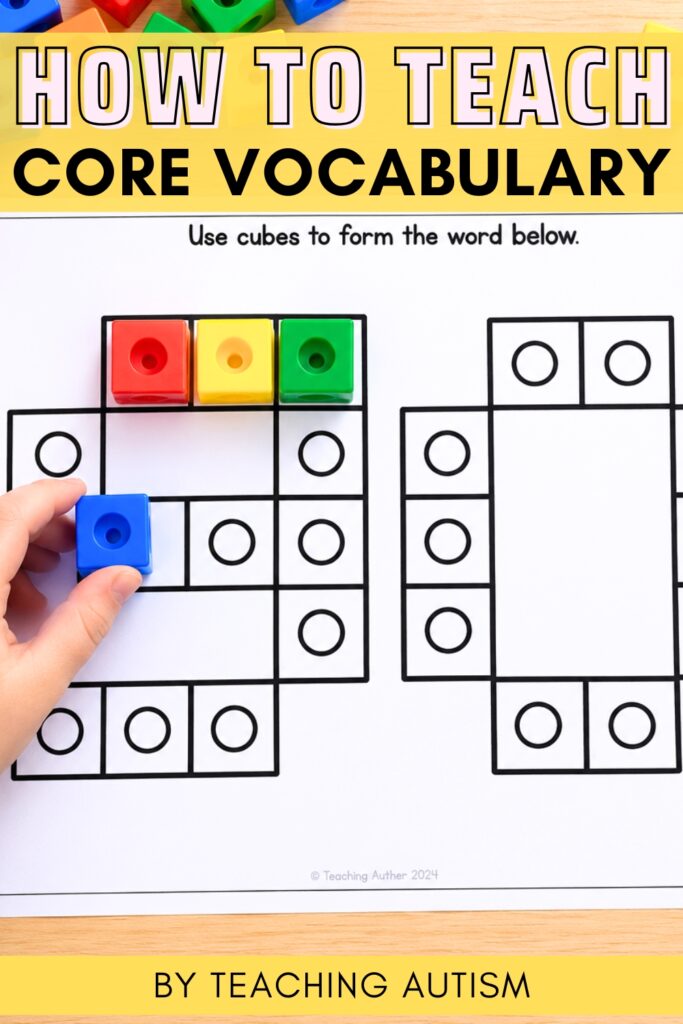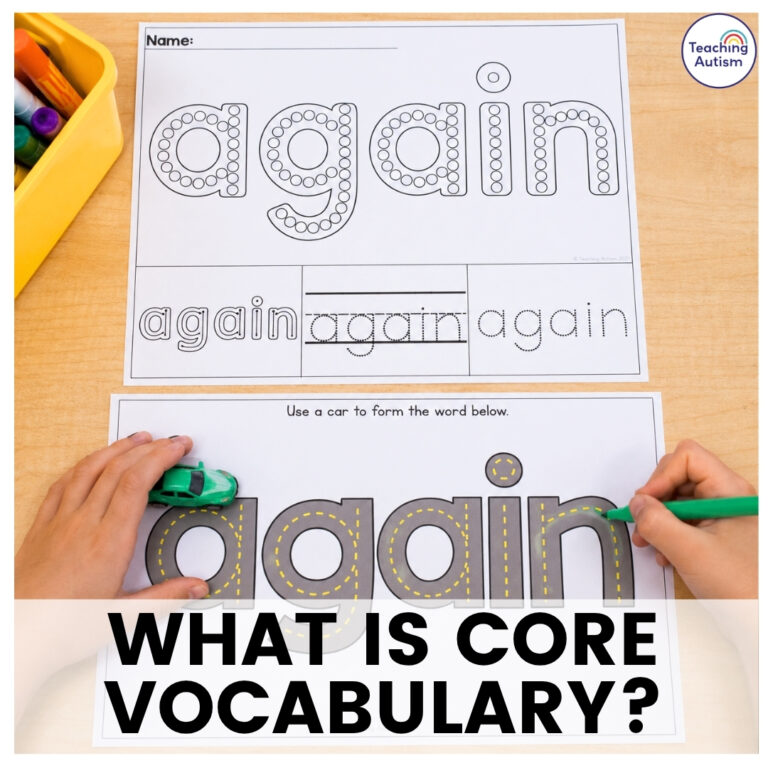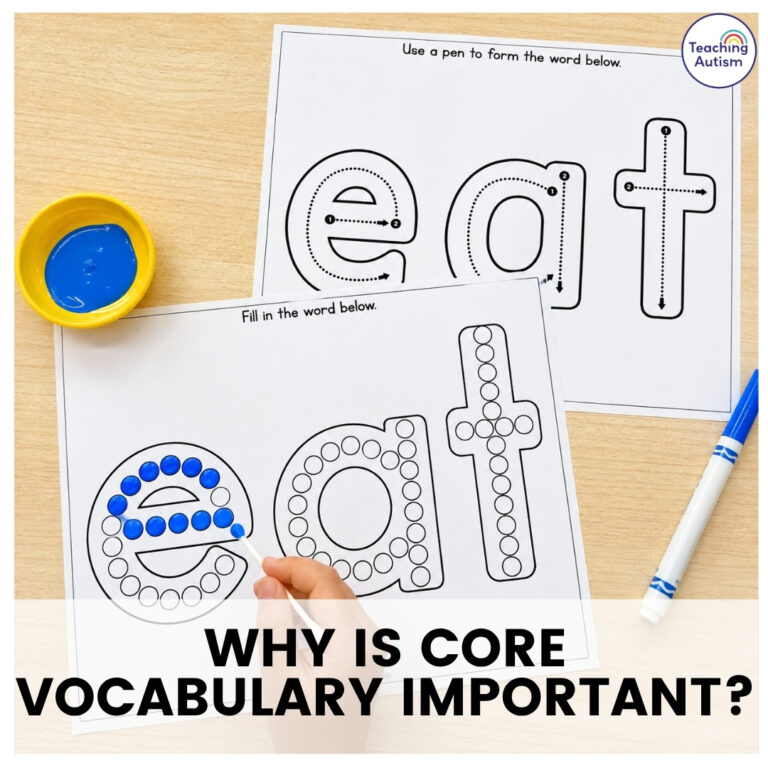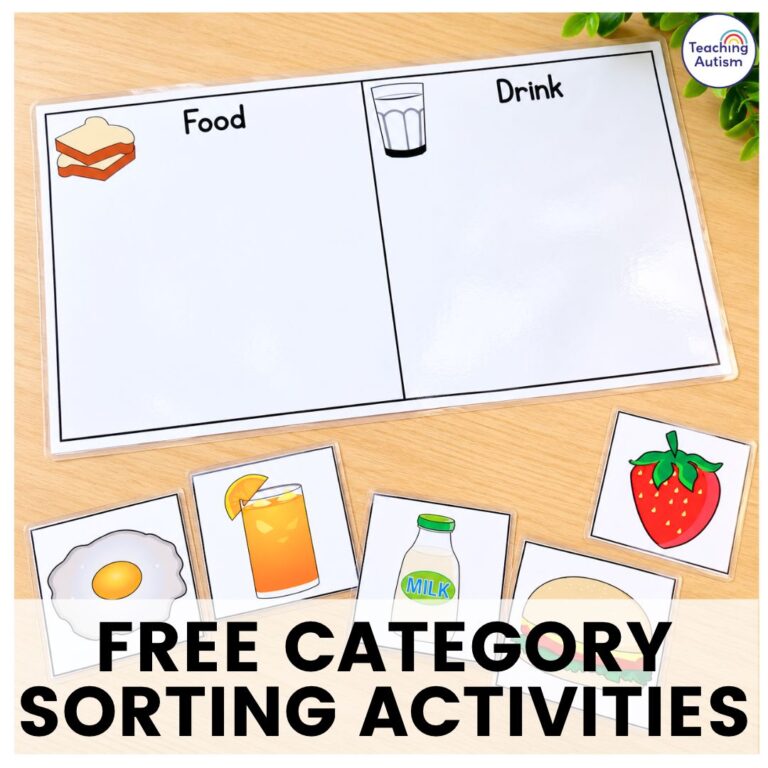
How to Teach Core Vocabulary in Special Education
How to teach core vocabulary in special education is one of the most common questions I get in my inbox. The question is usually from teachers who are just beginning their core vocabulary journey. And I’ll admit.. Core vocabulary can feel overwhelming at first. Especially when you’re trying to fit all of the communication goals into an already busy school day.
The good news though?
Teaching core vocabulary doesn’t have to be complicated! And it definitely doesn’t require setting aside hours every week for separate language lessons.
In my opinion, I think that the best core vocabulary teaching often happens naturally throughout your day.
Start with ONE core word at a time
One of the biggest mistakes teachers make is trying to introduce too many words all at once. Instead, what I like to do is focus on one core word for a week or two.
For example:
- Go
- Stop
- More
- Help
- Want
- In
- Out
- Up
When students hear the same word used in lots of different situations, they are going to begin to understand what it means.. And also when they can use it themselves.
Remember, repetition is your friend!
Model… model… and model some more
One of the most effective ways that I think you can teach core vocabulary is by modeling it to your students. In simple terms – I want you to use that word while pointing to it on the student’s AAC system or communication board.
For example:
If you’re playing with bubbles.. I want you to model “more!”
Or when you’re cleaning up… “Put it in”
Think of recess… “Go!”
During snack time.. “Do you want MORE?”
Your students are going to learn by seeing communication being used for real purposes, not just by constantly being tested or being shown flash cards.
Don’t worry if they don’t immediately repeat the words. Every time that you model it, you are building their understanding.
Teach core vocabulary all day long
Communication doesn’t just happen during speech therapy sessions.
It happens during:
- Morning meeting
- Centers
- Art
- Snack
- Lunch
- Recess
- PE
- Reading
- Sensory play
- Outdoor learning
The more opportunities that your students have to hear and use core vocabulary.. Then the faster those words are going to become meaningful for them.
Read books together
Books are one of my favorite ways to teach core vocabulary. When you read, I want you to pause and model your focus word.
For example, if you’re teaching the word look, you might say:
“Look! I see the dog.”
If you’re teaching go, point out every opportunity when a character in the book goes somewhere. Books provide lots of natural opportunities to hear the same word used over and over again.
Use play-based learning
It’s no secret that children learn best when they’re engaged. I always say to build your core vocabulary lessons around activities that your students already love.
You could use:
- Toy cars
- Play dough
- Blocks
- Sensory bins
- Ball games
- Building toys
- Dollhouses
- Farm animals
- Pretend play
For example, when building towers you might repeatedly model the following core words:
“Up.”
“More.”
“Go.”
“Stop.”
Learning feels much more natural when communication is part of play.
Incorporate movement
Some of the easiest core words to teach involve movement. And I know my students love to move around.
Think about words like:
- Up
- Down
- Go
- Stop
- In
- Out
Students can physically experience these words while hearing them at the same time.
Jump up.
Sit down.
Go fast.
Stop.
Walk in.
Walk out.
Movement helps to make abstract language much more meaningful for our students.
Don’t forget crafts!
If you’ve been following my blog for a while, you’ll know that I love using crafts in my classroom!
Crafts can create lots of natural opportunities to model communication for our students.
You might say:
“Glue on.”
“Put in.”
“More.”
“Help.”
“Open.”
Students are busy creating something fun while also hearing meaningful language throughout the activity. This is another great example of modeling that language.
Use visual supports
Many of our students benefit from having visual reminders available throughout the classroom. I am a huge advocate for having visual supports in all classroom. And they are great to use as part of supporting core vocabulary development in our students. Think of:
- AAC devices.
- Communication boards.
- Core word displays.
- Visual schedules.
- Portable communication books.
Having core words visible makes it much easier for adults to model them consistently.
Repeat words in different situations
One of the biggest strengths of core vocabulary is that the same word can be used in hundreds of different situations and in different environments.
Let’s look at the word open.
Open the door.
Open your lunchbox.
Can you open the book?
How do I open the paint?
Open the window.
Students begin to understand that words aren’t tied to one activity – they are flexible and useful everywhere. Those same words can be used as sentences, questions, responses.. In different situations, context, environments..
Keep it fun!
This might be the most important tip of all. Don’t turn core vocabulary into endless drills. Students learn best when things are fun.
Instead, I want you to try and:
- Play games.
- Read books.
- Go outside.
- Dance.
- Paint.
- Build.
- Sing songs.
- Bake.
- Explore.
The more enjoyable learning is, the more engaged your students will be.
Looking for ready-to-use core vocabulary activities?
Planning activities for every core word can take a lot of time, which is exactly why I created my Core Vocabulary Activities Bundle.
Each core word includes a huge variety of engaging activities designed specifically for special education classrooms, including:
- Adapted books
- Emergent readers
- Crafts
- Worksheets
- Play dough mats
- Matching activities
- Handwriting practice
- Writing activities
- Fine motor tasks
- And so much more!
Everything is designed to make teaching core vocabulary simple while giving your students lots of meaningful opportunities to practice communication throughout the day.
Take a look at my Core Vocabulary Activities Bundle here.
Teaching core vocabulary isn’t about finding the perfect lesson plan. I just want you to think about how you can create meaningful communication opportunities throughout every part of your day. Don’t over think it or put extra work load on yourself.
The more your students hear, see, and use core words in real-life situations, the more confident they are going to become as communicators.
I always recommend to start with one word. Model it often, make learning fun, and celebrate every little success along the way.
If you found this blog post helpful, please consider sharing it with your friends and colleagues on social media, it helps more teachers find support, and it means the world to me and my little family too.
And if you haven’t already, be sure to check out my Free Resource Library for tons of classroom tools, visuals, and printables to make your teaching life easier (and a whole lot more fun!).
P.S. Have you signed up for my VIP membership yet? If not, head on over and sign up now. You’ll get access to hundreds and hundreds of resources, templates, crafts and more being uploaded every month!
Nikki